
Anyone who follows the news – even remotely – knows that with the progress of Artificial Intelligence (AI), smart-healthy cities have taken off around the world. Urbanization continues. And all those people need to stay healthy in climate-adaptive cities and towns. It’s a complex story for designers and architects. America and Asia are leading the way, but the biomimicry technology of Venturial plays a significant role in the EU.
What are smart-healthy cities? They are full of buildings without sick-building syndrome that don’t off-gas into the interior. They are full of circular, reusable materials whose value is retained after their lifespan and reused. They are visionary architectural and design concepts in a circular economy.
And all of this is data driven. Because only with data can we know that manufacturers aren’t greenwashing. Venturial was founded by a designer-team. Sailors are at the forefront of the circular economy. Ellen MacArthur is a famous household name, and she is a sailor, just like Sandra and Stefan Baan.
They see plastics problems firsthand and know that products must be strong throughout their lifespan and quickly biodegradable in the sea. Or… industrially reusable afterward. It’s all a design. Designers and architects can make it happen if they choose to make material reuse passports with Venturial.
The smart-healthy design market is now enormous. Hospital costs are spiraling out of control, governments are going bankrupt, and what could be more important than public health and a clean-living environment? Healthy for humans in the lead.
The market is estimated to be worth approximately USD 952 billion to USD 2.25 trillion by 2025. Forecast 2030-2034: The market is expected to grow to between USD 3.7 trillion and USD 7.4 trillion by 2030-2033. Growth rate (CAGR): The market is growing at a compound annual growth rate (CAGR) of approximately 15% to over 25%.
And who knows this market better than a material design team that has been active in the field of sustainable materials, interior design, fashion, and healthy buildings for over 20 years?
“To Venturial” has become an established solutions technology in the circular economy!
What is new in this circular economy world? The real data-driven solutions without greenwashing. People-Planet-Profitable.
Hardware does what it needs to do. Emit health. But software-algorithms play their role of energy-efficient in the LCA too. AI provides futures and central insights into weather, climate, and a changing planet. Safety. Health. Blockchains are the decentralized digital currencies for an “Economy of Trust and Transparency.” Smart and data-driven contracts. Provenance of materials and products. Digital.
Why has this technology only recently become ready and mature? Data-mining algorithms were very energy-consuming in the past. But now – after Ethereum’s Merge in 2022 – the blockchain mining became 99.5% more energy efficient. It was no longer necessary for a miner to be next to a Chinese water-powerplant. Blockchains are ready for the new world.
Carbon credit and blue bond models – holding CO2 in the chains and saving drinking water – are easily certified and can be traded on an exchange. Compare it to a raw materials exchange or stock exchange. Calibrate your process and earn money by capturing CO2 into materials and holding it long, longer, longest in the supply chains of biobased buildings or biobased fiber polymers in automotive.
Or earn money by retaining freshwater on land longer and conserving water. DRY transport is easier to implement sustainably than wet transport. Don’t transport unnecessary moisture or hot air. Surfing the LCAs actively needs Venturial and a certifiable model with a material passport.
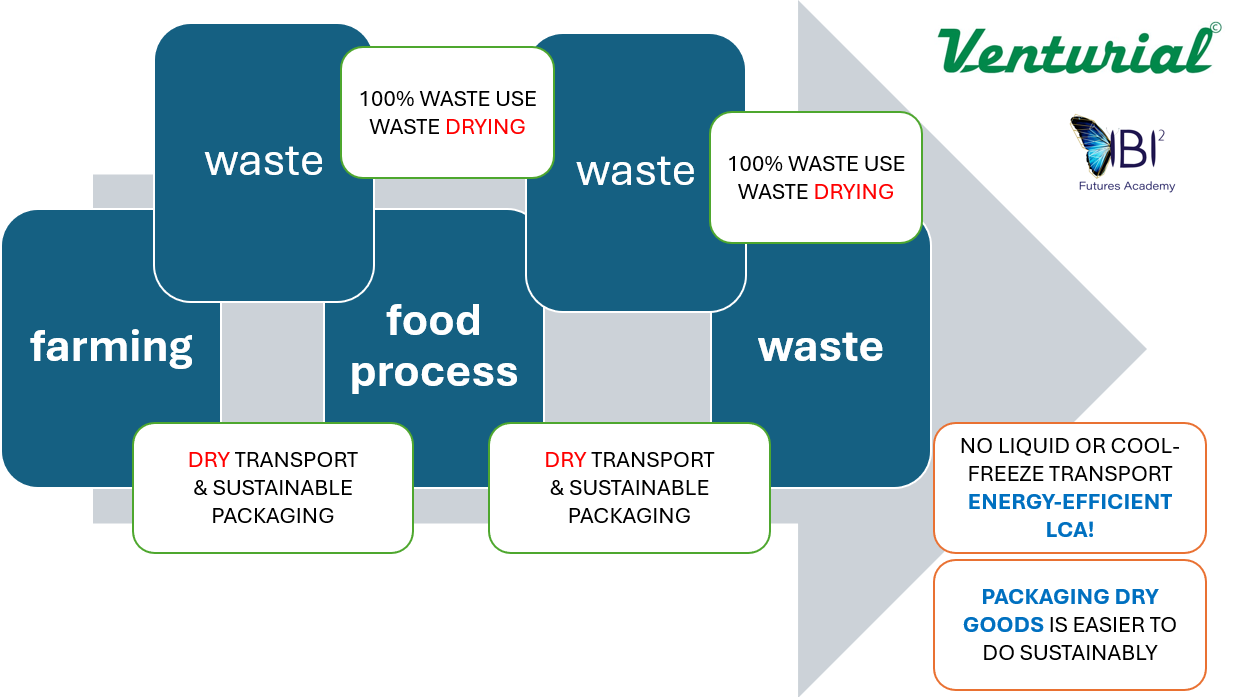
In the past, these monetary revenue streams were reserved only for carbon farmers who built healthy topsoil with CO2 inside. They were also reserved for sustainable companies that create freshwater, retain water on land, and conserve water. But thanks to “Venturialing,” the carbon can demonstrably remain in the supply chain long, longer, longest, and can guaranteed be reused at the end of its life cycle.
If the guarantee is there, the value is held too. Planet-People-Profit.
Smart girls and guys use, reuse, and reduce water!
Dutch Design does it beautifully!
Check out our projects page for our most recent examples. All projects demonstrate proven technology and material expertise. Easy to integrate into industrial processes.
This is the future for ALL smart-healthy cities.
Design – Design – Design *by Nature.